

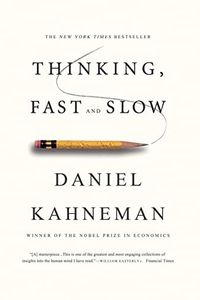






Thinking, Fast and Slow
The writing is academic with decades of controlled experiments.
Daniel Kahneman's Thinking, Fast and Slow provides the cognitive science framework for every misjudgment Gladwell describes in Talking to Strangers. Kahneman's distinction between System 1 (fast, intuitive, overconfident) and System 2 (slow, analytical, effortful) explains why people default to trusting strangers: System 1 generates confident assessments based on thin evidence and emotional cues, and most people never engage System 2 to question those assessments.
The book catalogs dozens of biases that affect how we read other people, including the halo effect, anchoring, and what-you-see-is-all-there-is. Where Gladwell illustrates these biases through dramatic case studies, Kahneman documents them through decades of controlled experiments.
The writing is more academic and comprehensive than Gladwell's, organized as a tour through the mind's error-prone machinery. Readers who appreciated Talking to Strangers' argument that we are worse judges of character than we think will find Kahneman provides the deep explanation of why that is true across every domain of human judgment.