

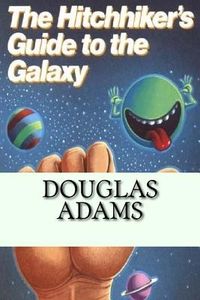


The Hitchhiker's Guide to the Galaxy
Outer space replaces magical Discworld.
The Hitchhiker's Guide to the Galaxy by Douglas Adams is the science fiction equivalent of what Pratchett does for fantasy. Arthur Dent's house is about to be demolished. Then the Earth is demolished. Then things get weird.
Adams writes comedy that works on multiple levels: there is slapstick, there is wordplay, and underneath it all, there is genuine philosophical anxiety about the meaninglessness of existence. The Guide itself, an electronic encyclopedia full of unreliable advice, anticipates Wikipedia by twenty years. Adams and Pratchett share a gift for making the absurd feel logical. Both writers create rules for their universes and then follow those rules to their most ridiculous conclusions.
The Infinite Improbability Drive, the answer to the Ultimate Question, and the depressed robot Marvin all operate on the same principle as Pratchett's magical luggage: take a silly idea, commit to it completely, and let the comedy emerge from internal consistency. Adams's prose is leaner than Pratchett's, with fewer digressions but equally sharp observations about human nature masquerading as alien encounters.