

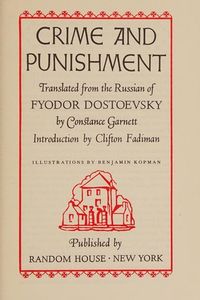






Crime and Punishment
A murder, not an affair, triggers the psychological unraveling.
Fyodor Dostoevsky's Crime and Punishment follows Raskolnikov, a destitute former student in St. Petersburg who convinces himself that murdering a pawnbroker is morally justified. The novel traces his psychological disintegration after the act and his slow movement toward confession and redemption.
Like Anna Karenina, the book is set in nineteenth-century Russia and creates an intimate portrait of a mind at war with itself, surrounded by a society indifferent to individual suffering. Dostoevsky writes about guilt, faith, and the limits of rationality with an intensity that matches Tolstoy's treatment of Anna's inner turmoil, though his style is more feverish where Tolstoy's is more measured. Both novels insist that actions have moral consequences that cannot be escaped through philosophy or social standing.
Raskolnikov's St. Petersburg is hot, crowded, and claustrophobic, a stark contrast to the grand estates of Anna Karenina, but both settings reflect the psychological states of their protagonists. Readers who admire Tolstoy's moral seriousness will find Dostoevsky an essential companion.